
A selection of our clients









The firm's data ecosystem, in one intelligent engine.
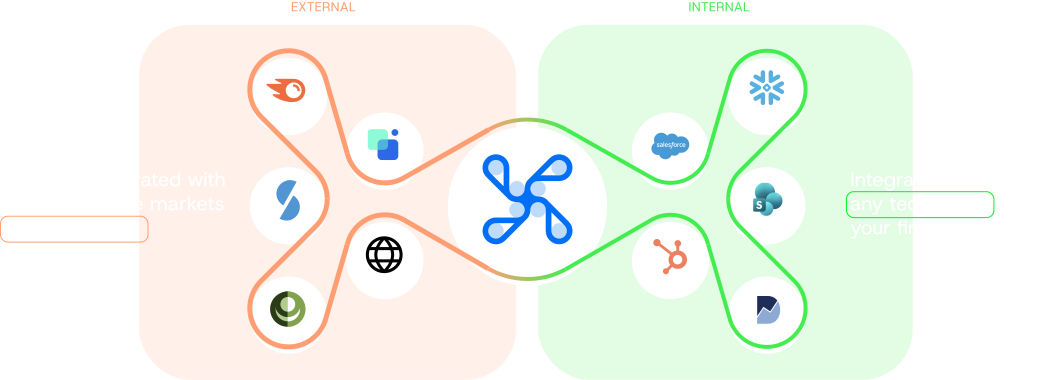
Integrate all internal and external data sources into a living, learning data engine built to optimize dealmaking and drive sustained competitive advantage for your firm.
.svg)

Helping tech leadership get data in the fast lane
Our purpose-built data engine pulls together your entire market and proprietary data ecosystem, fueling your AI roadmap.

Agentic AI for PE, from origination to value creation
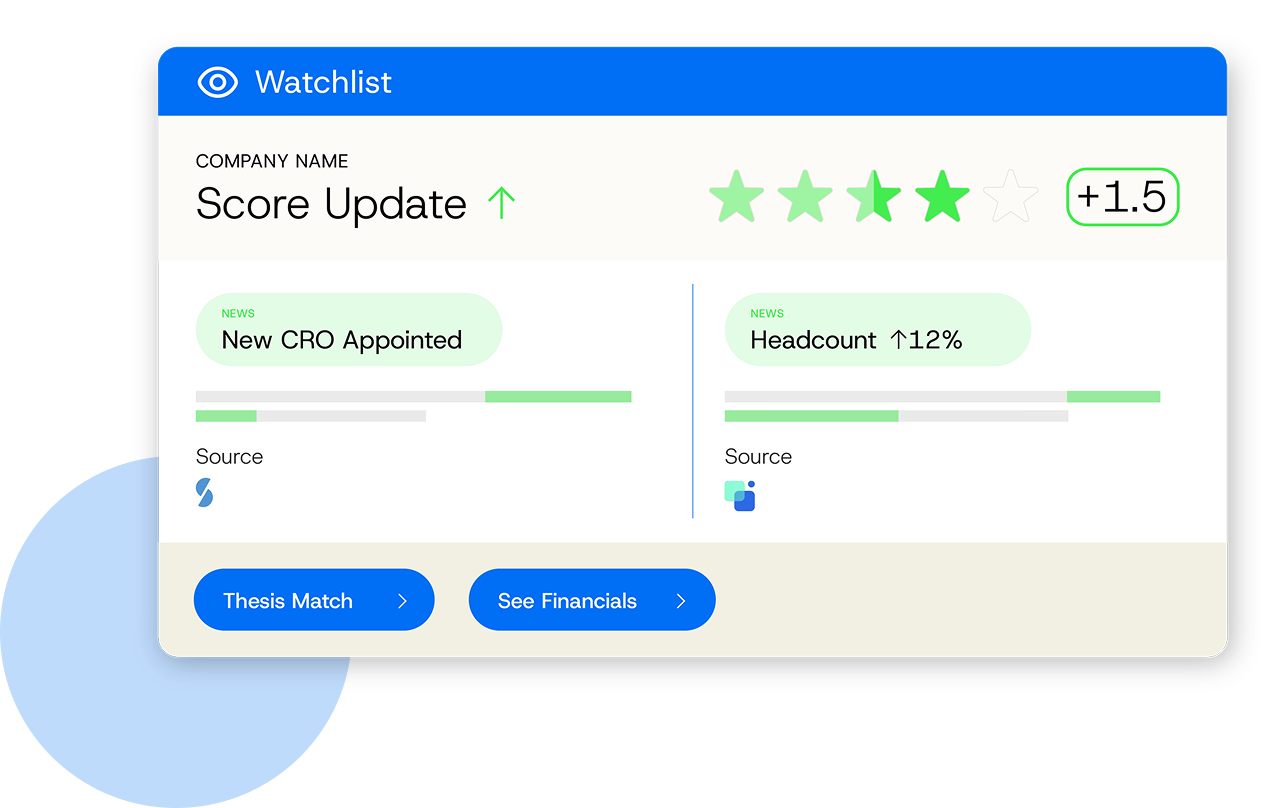
Empower origination teams with codified scoring, net-new recommendations, watchlists and tracked deals.
Connecting the unconnected in dealmaking
Unifying the data, intelligence, and signals that exist for private equity firms, and transforming it into deals.
Finally, a platform your firm can truly customize
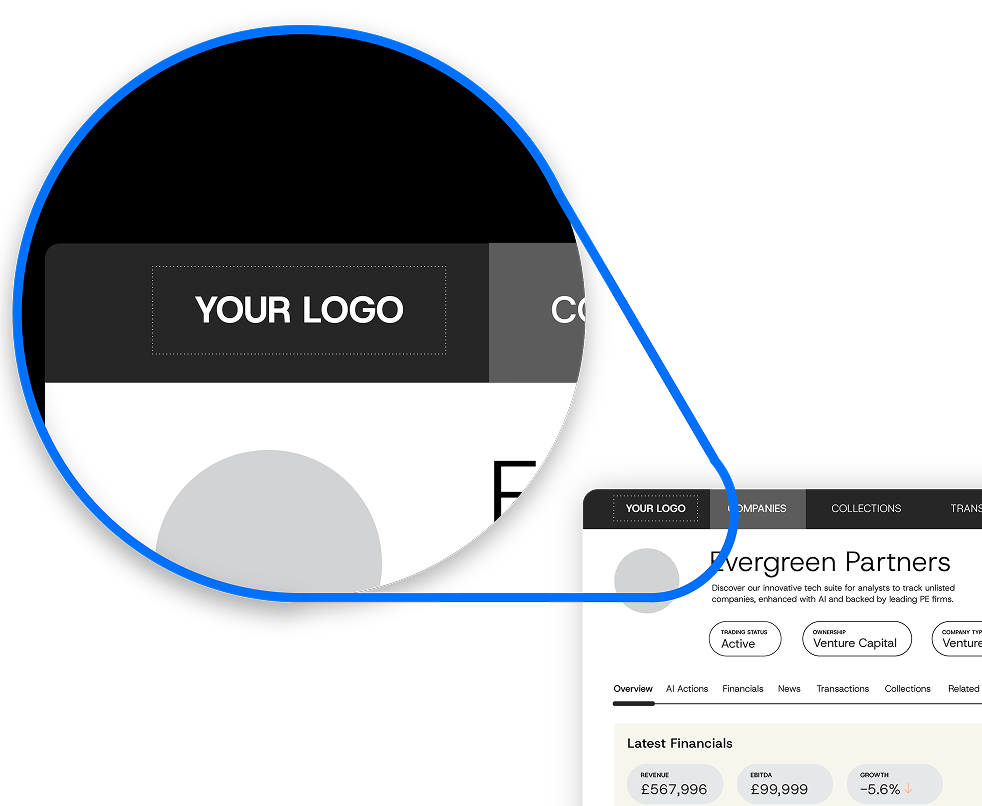
Deal Engine is offered as a white-labelled solution, resulting in faster onboarding, adoption, brand alignment and organizational buy-in.
Find more net new deals for your firm
Codify your strategy, track the market and increase relevance. Deal Engine delivers always-on agentic AI intelligence that continuously monitors your entire investable universe — specified by your thesis — and surfaces high-fit targets.
Unify data, unlock insights
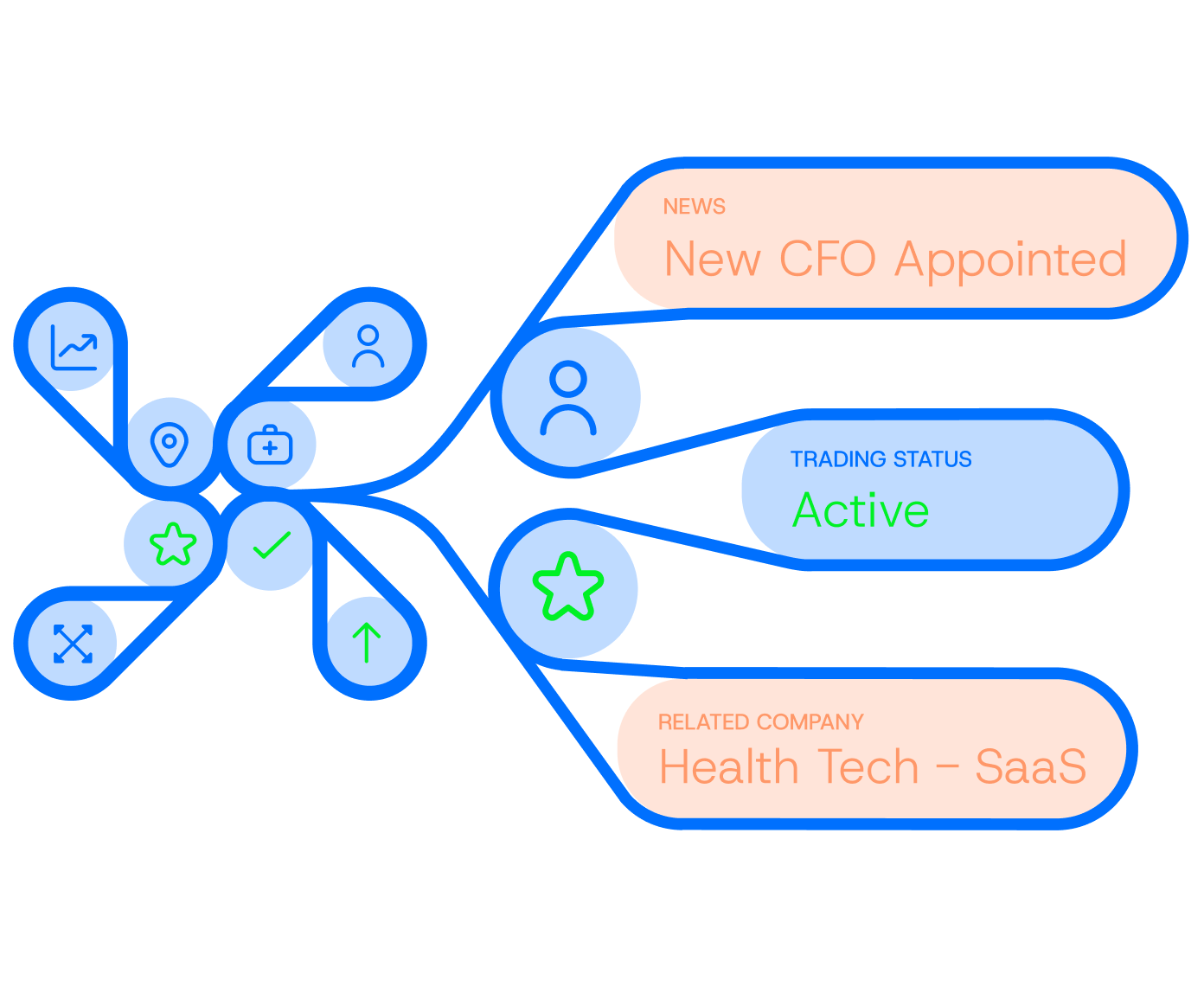
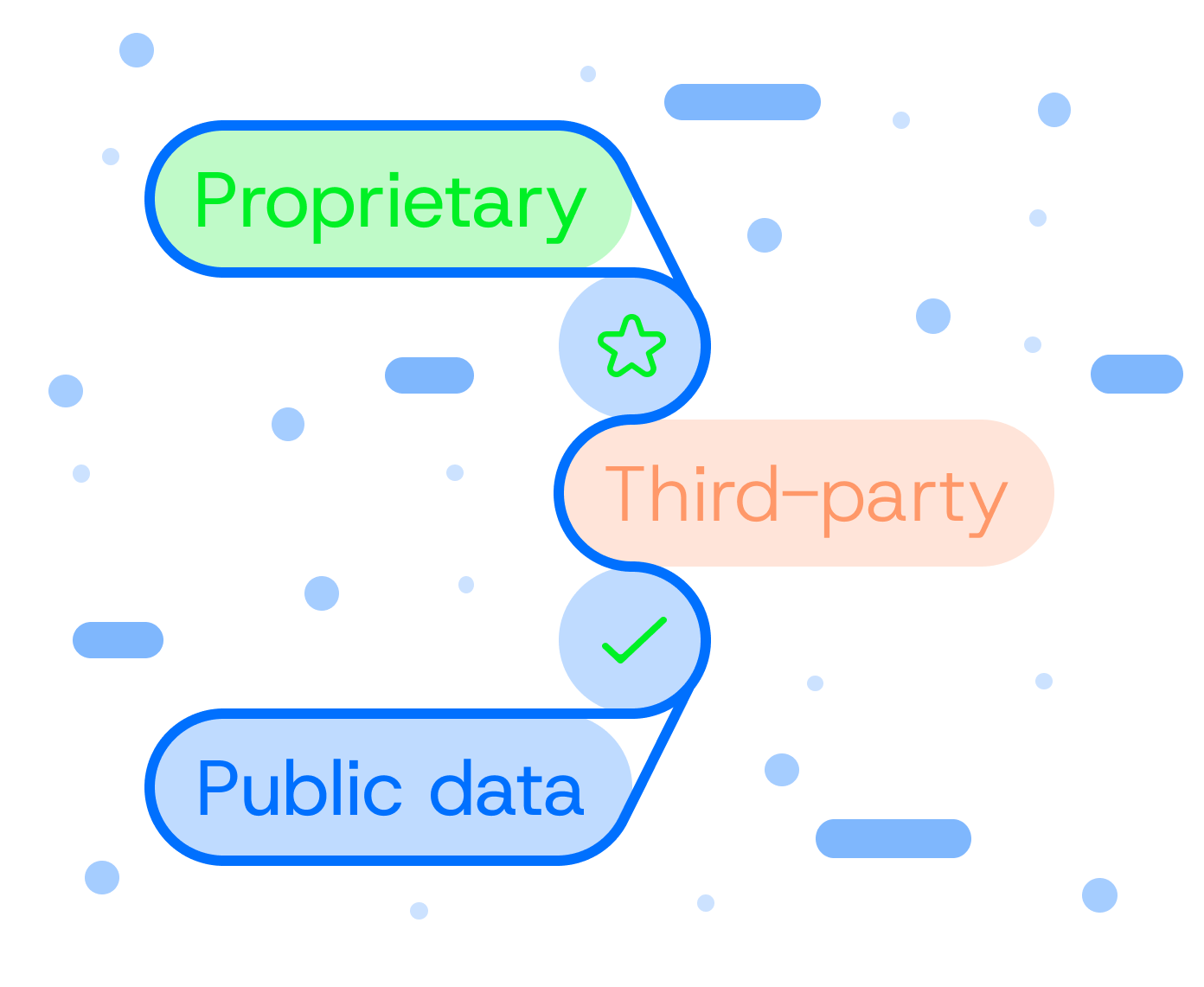
White-label the technology and make your Deal Engine entirely yours. Deal Engine brings together proprietary, third-party, and public data into a single connected layer, transforming information into actionable intelligence.
Power up instead of piling on
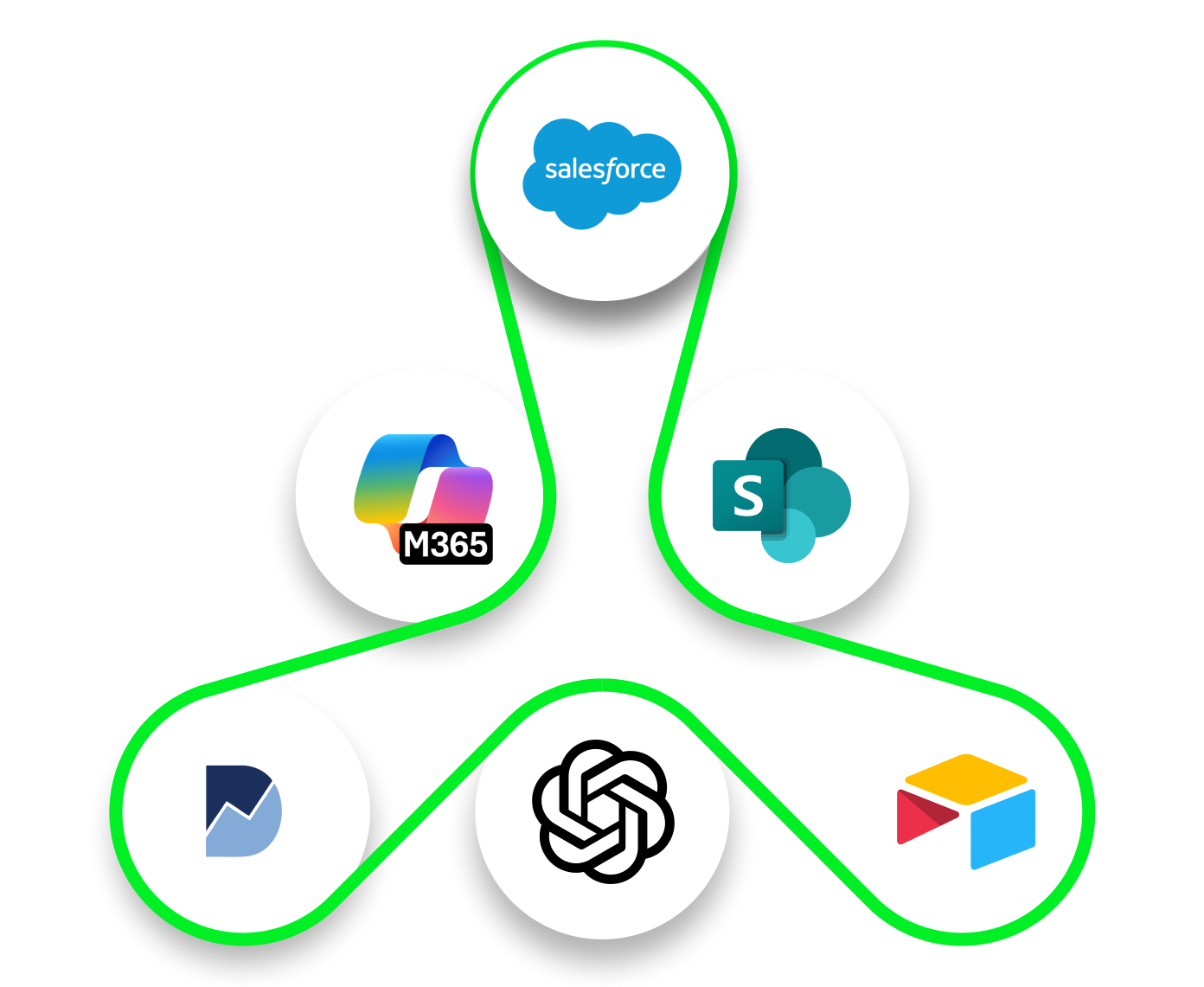
Optimize your data spend and unlock the value in your CRM and internal documents. Deal Engine enriches your CRM with structured, intelligent data without adding clutter, complimenting your existing tech stack instead of complicating it.
Build the gen AI-enabled firm of tomorrow
Fuel your AI roadmap with an integrated agentic AI intelligence layer. Accumulate and train your firm’s own proprietary dealmaking engine, built to evolve with your strategy and scale firm-wide tech-readiness.
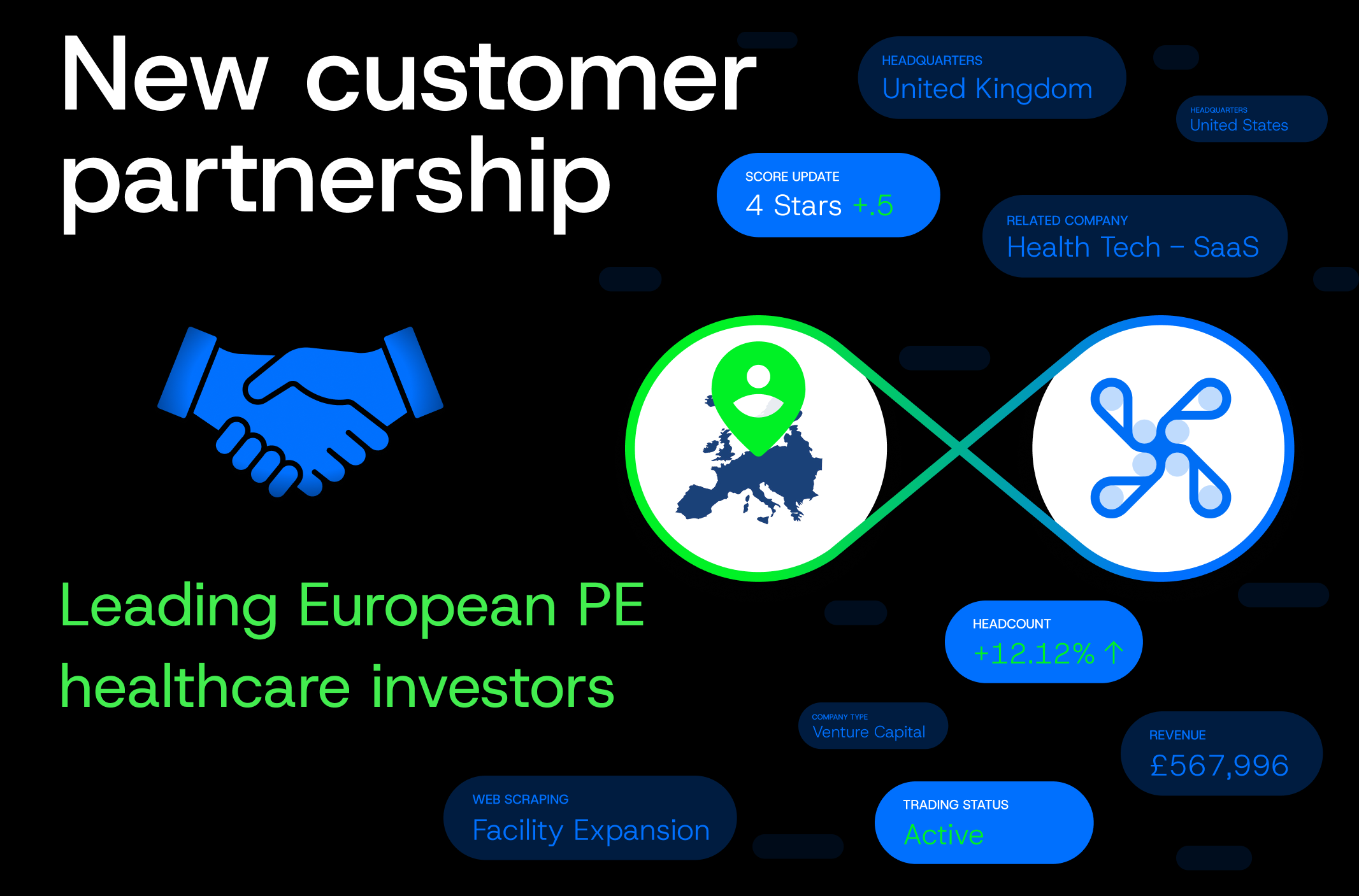
Leading healthcare investor chooses deal engine to power data and AI strategy
LONDON, UK, April 2026: Deal Engine (formerly Filament Syfter), the category-defining dealmaking data engine for private markets, today announced that a leading European healthcare-focused private equity firm with approximately €9bn in assets under management has begun onboarding Deal Engine technology to support its data strategy through a more unified data and AI foundation.
Why using Claude alone doesn’t scale in private markets
Claude and other frontier LLMs have fundamentally changed how work gets done in private markets. For the first time, deal teams can interact with multiple data sources through a single interface. A prompt can pull together CRM data, market context, comparable transactions, and publicly available information into a structured output in minutes. It is a genuine step forward. It also creates a very natural question: If Claude can do all of this, do we still need anything else? The answer is not about limitations in the model. It is about what happens around it. What Claude does extremely well It is worth being clear about where Claude excels. It is highly effective at orchestrating data across multiple sources. It can combine internal systems, third-party providers, and public data into a single response. It can generate structured outputs such as pre-IC memos, company summaries, and market maps with very little input. It also introduces the concept of skills, which allow firms to begin standardizing how tasks are executed. With the right setup, Claude can be guided to follow consistent workflows. For individual productivity, this is transformative. Tasks that previously required hours of manual effort can now be completed quickly and with a high degree of quality. In many cases, this is enough to unlock immediate value. The challenge is not what Claude can do. It is what happens after the output is generated. Where firms run into challenges Most workflows in Claude follow a simple pattern. A user submits a prompt, the model retrieves and processes relevant information, and an output is returned. That interaction is complete in that moment. For many use cases, this is exactly what is needed. However, private markets workflows rarely exist at a single point in time. They develop over weeks, months, and often years. This is where relying on Claude alone can introduce challenges. 1. outputs are not automatically carried forward Claude generates high-quality outputs, but it does not automatically capture or structure them for future use. In practice, this means that valuable insights can remain within individual conversations unless they are manually extracted and stored elsewhere. Over time, this makes it harder to build a consistent, evolving view of companies and markets. Each interaction is valuable, but the connection between them is not maintained. 2. work is often repeated across teams In a team environment, it is common for multiple people to explore similar questions. Without a shared layer of context, those questions are often asked independently. Claude will produce a useful answer each time, but it has no awareness of what has already been done by others. This can lead to duplication of effort and variation in outputs, even when teams are working toward the same objective. 3. “not yet” opportunities are harder to track A large part of deal sourcing is not about immediate decisions. Many companies fall into a “not yet” category, where they are not currently actionable but may become relevant over time. Claude can analyze these companies effectively in the moment. However, it does not track them over time unless it is prompted again. Supporting this type of workflow typically requires a way to persist and revisit prior analysis, as well as to monitor changes as they happen. 4. continuous workflows require additional structure Claude operates in response to prompts. It generates outputs when asked, but it does not run continuously in the background. Many high-value workflows in private markets, such as monitoring pipelines or tracking companies, are ongoing by nature. They benefit from a system that can surface changes without requiring constant manual input. This is less about replacing Claude, and more about extending how it is used. 5. skills require structure to scale effectively Claude’s skills capability is a powerful way to guide how tasks are executed. However, building reliable and consistent workflows still requires structure. In practice, this involves defining inputs, outputs, and logic in a way that produces repeatable results. As workflows become more complex, maintaining that consistency can require ongoing effort. This is not a limitation, but it does mean that scaling usage across a team typically benefits from a more structured approach. 6. efficiency depends on how usage is structured As adoption increases, patterns of usage become more important. When similar queries are run multiple times across a team, Claude will process the same data repeatedly. This is often necessary in a prompt-based workflow, but it can introduce inefficiencies over time. Providing a way to build on prior work, rather than repeating it, can improve both consistency and efficiency. The underlying shift: from tool to operating model Taken together, these points highlight a broader shift. Claude and other frontier LLMs are best understood as an interface. They provide a powerful way to access and interact with data. However, scaling their impact requires an operating model around them. This typically includes: a way to capture and structure outputs a shared layer of context across the team workflows that can be standardized and reused the ability to track and monitor activity over time What changes with a context layer When a context layer is introduced alongside Claude, the role of the model becomes even more powerful. Outputs are no longer isolated. They are captured, structured, and connected to other work. Teams can build on previous analysis rather than starting from scratch. Workflows can extend beyond individual prompts. Companies can be tracked over time, and relevant changes can be surfaced as they occur. This does not replace Claude. It complements it. Claude remains the interface through which work is carried out. The context layer enables that work to accumulate and improve over time. A significant step forward for private markets Claude and other frontier LLMs represent a significant step forward for private markets. They make it easier to generate insights, explore opportunities, and reduce the time required for many tasks. However, using Claude on its own is not the same as having a scalable system. Firms that rely solely on the interface will see clear gains in productivity, but may find it difficult to extend those gains across a team or over time. Firms that introduce the right operating model alongside it can turn those same capabilities into something more durable. Claude provides the interface. The operating model determines whether the work builds over time. Talk to us to see how you can set up your operating model with Claude or other Frontier LLMs.
Why AI success in private equity has nothing to do with the model
There’s no shortage of conversation around AI in private equity right now. New tools, new models, new use cases. But most of that discussion is focused on the wrong thing.
3 reasons why AI stalls in private equity
Firms are investing in AI and running pilots. But meaningful change has been slow to follow. This post is a companion piece to our guide, Why every private equity firm needs a proprietary market data engine. If you want to go deeper on the architecture behind these ideas, the guide covers the full picture.