
What's new in Deal Engine: Q1 2026 product update
Chas Frederick
Chas Frederick, Product Manager, Deal Engine
Over the past quarter, a lot of conversation in private markets has centered on AI. Most of it focuses on models; which one to use, how to deploy them, what they can automate - But in practice, the limiting factor is rarely the model.
It is the data, the context, and the workflows those models are applied to. If the underlying data is fragmented, if institutional knowledge sits in inboxes and spreadsheets, and if workflows are still manual, then even the most capable models will struggle to produce consistent, useful output.
This is the gap we have been focused on since we started building Deal Engine. Our recent guide on building a data engine explores this in more detail, along with the shift from AI experimentation to AI infrastructure. Alongside that, our latest article on Claude and other frontier models looks at how these technologies actually get applied inside firms. The product updates we shipped in Q1 are a direct extension of that thinking.
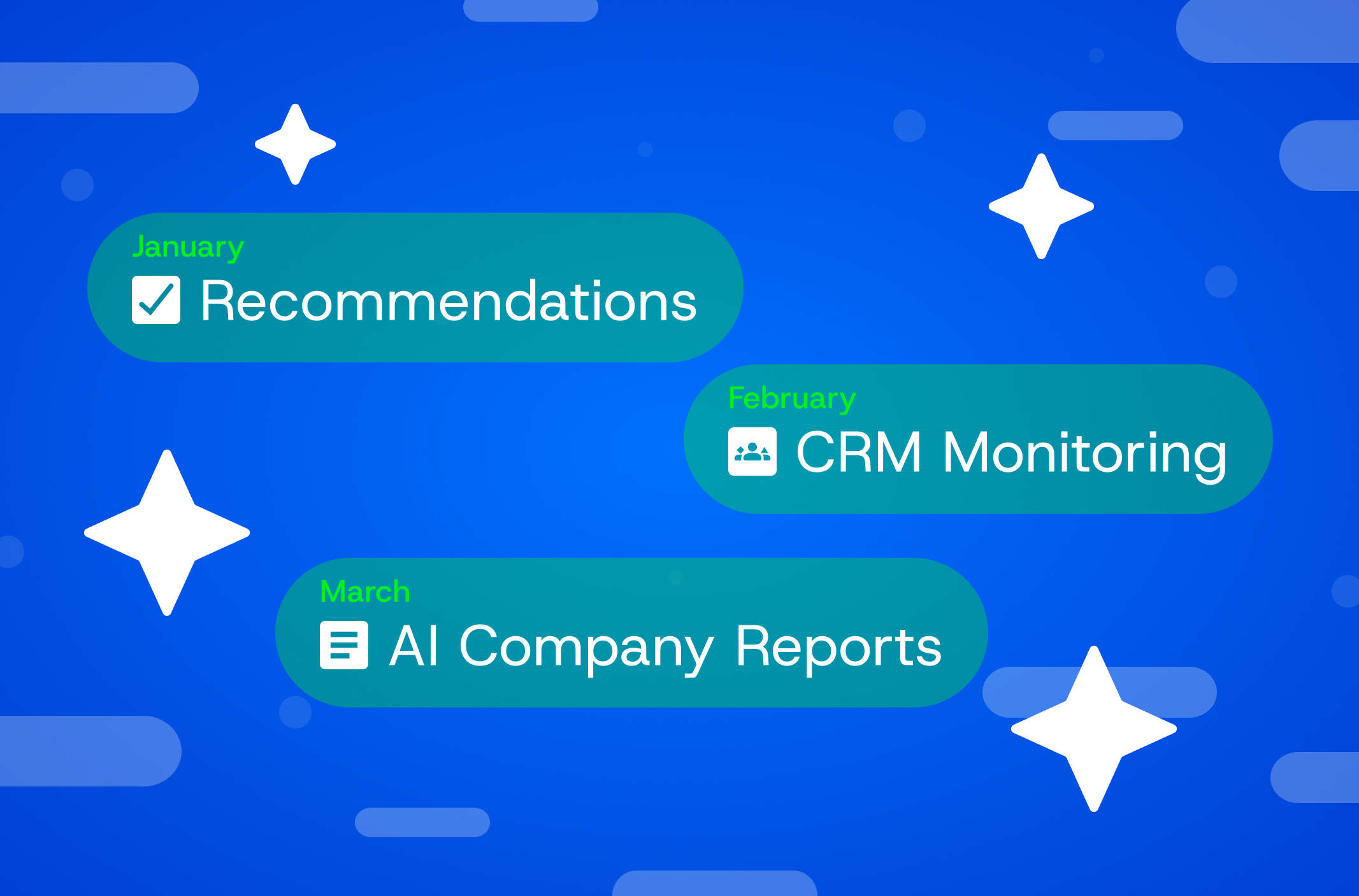
More relevant, thesis-specific recommendations
One of the biggest challenges in origination is getting from a broad universe of companies to a shortlist that is actually worth spending time on.
Traditionally, this is done using filters: revenue ranges, sectors, geographies, growth rates. These are useful, but they rarely capture how a firm really thinks about investment fit. As a result, teams often generate large lists and then spend time offline using spreadsheets, manually reviewing and refining them.
What's new
Deal Engine now supports recommendation agents built around individual investment theses. Instead of defining a single set of rules for the entire platform, firms define what a strong fit looks like for a specific strategy. This can include example companies that represent a good fit, optional examples of companies that are not a fit, and structured criteria such as sector, size or geography.
The system then combines two layers: a criteria-based layer that filters the universe based on structured data, and an AI layer that learns patterns from your examples and applies them across both structured and unstructured data, including company websites and news. Each thesis runs as its own agent, continuously reviewing new data and updating results.
What this looks like day to day
Instead of generating a long list and working through it manually, users receive a short daily list of companies aligned to each investment thesis, a clear explanation of why each company has been surfaced, and simple actions to accept or reject companies — which further improves future results. Multiple strategies can run in parallel without overlap.
For private equity firms
- Build and maintain multiple origination pipelines aligned to different investment theses
- Continuously scan the market for new opportunities without manual list building
For investment banks and corporate finance teams
- Identify potential mandates that align with sector expertise or deal type
- Support origination teams with a steady flow of relevant, pre-qualified opportunities
CRM monitoring: turning existing coverage into active signals
Most firms already have a significant amount of valuable information in their CRM. The challenge is that it is typically static. Companies are added, tagged and occasionally reviewed, but changes in those companies are not tracked in any systematic way. Opportunities are often missed simply because no one is looking at the right company at the right time.
What's new
CRM monitoring turns your existing CRM into a continuously updating source of signals. The platform monitors companies you already track and surfaces meaningful changes — hiring activity or senior leadership moves, expansion into new markets, participation in events, increased market visibility — using AI models aligned to your firm's data structure and investment focus. This feature is now live.
What this looks like day to day
Users have access to a dedicated dashboard showing companies with recent, relevant changes, a clear explanation of what has changed and why it matters, filters by CRM tier, owner or category, and the ability to mark updates as reviewed and track history over time. Outreach can be timed around real developments rather than scheduled check-ins.
For private equity firms
- Re-engage portfolio targets when something meaningful changes
- Maintain consistent, active coverage across sectors without manual effort
For investment banks
- Spot potential deal opportunities within existing relationships
- Prioritize outreach based on real-world triggers rather than periodic list reviews
AI company reports: structured context, on demand
Preparing for a meeting or assessing a new company often involves pulling together information from multiple sources — CRM notes, emails, recent news, internal discussions. This process is time-consuming and tends to produce inconsistent outputs across teams.
What's new
AI company reports automate this by turning your internal data and external context into structured summaries. Reports are generated based on prompts tailored to your firm and combine historical CRM interactions and relationship data, recent company developments and market signals, and structured summaries aligned to your investment thesis. They can be generated on demand, delivered by email, and stored within the platform. This feature is moving out of beta.
What this looks like day to day
Users can trigger reports for different purposes: a profile to assess whether a company fits a thesis, a pre-meeting brief combining the latest updates and relationship history, or structured content for internal investment discussions. Reports are only regenerated when needed, so they remain relevant without unnecessary duplication.
For private equity firms
- Faster screening and evaluation of potential targets
- Consistent preparation across deal teams, regardless of who owns the relationship
For investment banks
- Better-prepared client meetings with less manual assembly
- Repeatable, high-quality input for pitches and internal materials
Why this is harder to get right than it looks
There is a version of this where a firm decides to build something similar themselves. Connect a frontier model to the CRM, wire up a few integrations, prompt engineer your way to a recommendation engine. The tools are more accessible than ever, and the temptation to move fast is real.
But the risks of doing this without the right foundations in place are also real, and they are not always obvious until something goes wrong.
Data governance is the first one. Connecting AI tooling to live CRM systems, client data, and deal records without a clear architecture for what gets accessed, logged, and retained creates exposure that most firms are not equipped to manage. The rise of MCP and similar protocols has made it significantly easier to build integrations, and significantly easier to accidentally expose sensitive data to systems that were never designed to handle it.
Consistency is the second. Models without the right context produce inconsistent output. A recommendation agent that works well for one partner's thesis but surfaces irrelevant results for another, or an AI report that reflects six-month-old CRM data, creates more noise than signal. The value of these tools depends entirely on the quality and structure of the data underneath them.
This is why we exist. Not just to provide the features, but to be the partner that has already solved for these problems, so firms don't have to learn through trial and error with their own client data on the line.
Every capability we build is designed with data governance, consistency, and firm-specific context in mind from the start. That is not something you can retrofit.
Where this is heading
These three updates reflect a consistent direction.
Moving from manual, list-based workflows to systems that continuously interpret and act on data. Moving from static records to active signals. Moving from fragmented information to structured, reusable context.
This is the foundation required to make meaningful use of frontier AI models in private markets, and it is what we are focused on building, quarter by quarter, for the PE firms and investment banks we work with.
We are committed to this work for the long term. That means helping private market firms build the foundational architecture and orchestration layer to make your existing tech stack and data work harder, and when the Next Big Thing in tech and AI is released you'll be able to harness it to support your workflow.
If you want to see how Deal Engine works in practice, we would be glad to show you.
If you are exploring how to build the data infrastructure that makes AI useful, our data engine guide sets out the practical steps. And if you want to understand how models like Claude fit into that picture, our recent article goes deeper.
Don't miss perspectives like this
Sign up to our mailing list to get insights on tech, data and AI for dealmaking efficiency in private equity, corporate finance and M&A markets.
Your AI is only as powerful as the context behind it
Stop layering tools on fragmented data. Turn market data and your own proprietary information into structured advantage to source, prioritize and surface opportunities aligned to your investment thesis.
Related Posts
Be first to every deal.
See Deal Engine in action.
Discover how Deal Engine is providing private equity firms with the data engineering and AI capabilities fueling their competitive advantage.